
Heishansaurus

Heishansaurus pachycephalus is a dubious genus of armored herbivorous dinosaur, probably an ankylosaurid, from the Late Cretaceous of what is now Gansu in north-western China. Its fragmentary fossils were found near Jiayuguan, and no reliable body length estimate has been established from the known material.
Scientific name: Heishansaurus pachycephalus
Name meaning: Black Mountain lizard
Clade: Dinosauria
Family: Ankylosauridae?
Era: Late Cretaceous (Campanian–Maastrichtian, ~83.6–66 million years ago)
Length: Unknown
Diet: Herbivore
Location: Gansu, China
Fossils: Fragmentary skull, vertebrae, osteoderms, and dermal scutes.
Heishansaurus Life Reconstruction and Illustration
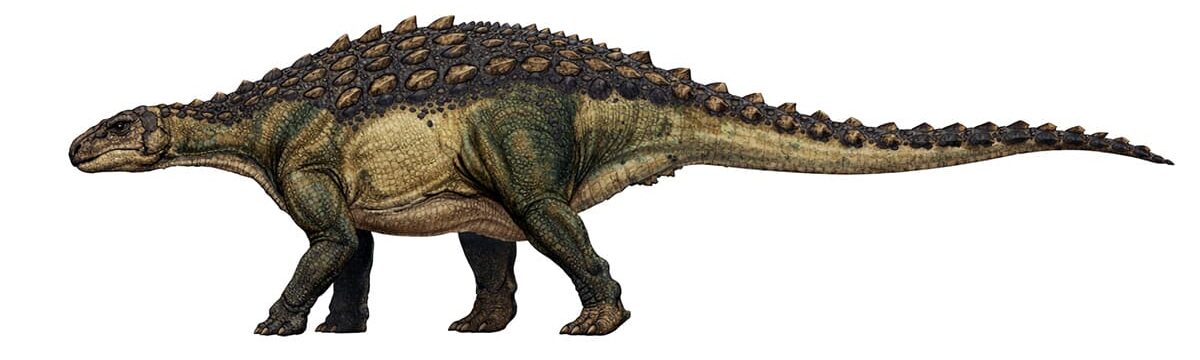
The reconstruction of Heishansaurus is based on the limited fossil material known from the genus, including fragments of the skull, vertebrae, and pieces of armor. Because the remains are incomplete, paleontologists rely on the well-preserved skeletons of related ankylosaur dinosaurs to estimate body proportions, stance, and overall shape. These comparisons suggest a low, heavily built animal with strong limbs, a long tail, and extensive dermal armor.
The arrangement of bony plates and body outline follows patterns seen in better-known ankylosaurs, which possessed rows of osteoderms across the back and sides. Skin texture is inferred from fossilized impressions found in armored dinosaurs and other ornithischians, showing thick, pebbly scales. Colour choices draw inspiration from modern reptiles such as lizards and crocodilians, which often display muted greens, browns, and earth tones suited to camouflage in natural environments.
Heishansaurus Facts
Heishansaurus is an obscure armored dinosaur known from fragmentary fossils discovered in north-western China. Most researchers interpret it as a type of ankylosaur, a group of heavily armored plant-eating dinosaurs that lived during the Late Cretaceous.
What makes Heishansaurus noteworthy today is mainly its scientific status:
- It was named from fossils discovered in Gansu Province, China.
- The remains include fragments of the skull, vertebrae, and pieces of armor.
- Most researchers consider the genus doubtful because the fossils are too incomplete for clear identification.
The genus is considered scientifically uncertain. The known fossils are incomplete and lack distinctive features, so many paleontologists classify it as a nomen dubium, meaning the material may not represent a clearly identifiable dinosaur.
Discovery and Naming
Heishansaurus was first described by the Swedish paleontologist Birger Bohlin during the twentieth century. The name means “Black Mountain lizard,” referring to the Heishan region in Gansu Province of north-western China where the fossils were discovered.
The original material was collected from the Jiayuguan area during scientific expeditions exploring the geology and fossil deposits of north-western China. These expeditions uncovered several fragmentary dinosaur remains preserved within sedimentary rock layers.
The holotype specimen includes portions of the skull and fragments of the skeleton along with dermal armor. Although the remains are incomplete, they provided enough information for Bohlin to establish the genus and describe its basic characteristics in the original species description.
Age and Environment
The fossils attributed to Heishansaurus come from Late Cretaceous deposits in what is now Gansu Province in China. These sediments formed during the Campanian to Maastrichtian stages, roughly between 83 and 66 million years ago.
At that time northern China supported diverse dinosaur ecosystems. The region included river plains and seasonal landscapes with vegetation capable of sustaining large populations of herbivorous dinosaurs and the predators that hunted them.
Classification and Scientific Status
Heishansaurus is usually placed among the ankylosaurs, a group of heavily armored herbivorous dinosaurs that lived during the Late Cretaceous. Ankylosaurs are known for their protective osteoderms, low bodies, and defensive adaptations against predators.
The fossils attributed to Heishansaurus are fragmentary, which makes its exact classification difficult. Paleontologists recovered partial skull elements, vertebrae, and pieces of armor. Because the material is incomplete, researchers cannot clearly distinguish it from other ankylosaur species.
For this reason, Heishansaurus is often labeled a nomen dubium. This term means the available fossils are not diagnostic enough to confirm a separate genus. Many fragmentary dinosaur fossils receive this status when they lack distinctive anatomical features.
Early interpretations also contributed to the uncertainty. When the remains were first studied, some researchers thought the animal might belong to a different dinosaur group before later comparisons suggested ankylosaur relationships. Today it remains an uncertain genus within the armored dinosaur lineage.
Diet and Appearance
Heishansaurus is interpreted as a plant-eating dinosaur. Like other ankylosaurs, it probably fed on low-growing vegetation such as ferns, shrubs, and other prehistoric plants. Its body armor would have helped protect it from carnivorous dinosaurs.
Although only fragmentary fossils are known, comparisons with related ankylosaurs suggest a slow-moving animal built for defense rather than speed. Thick bony plates embedded in the skin likely formed a protective covering across the body.