
Eucoelophysis

Eucoelophysis is a small dinosauriform from the Late Triassic of what is now New Mexico, United States. Fossils come from the Chinle Formation near Ghost Ranch. First described in 1999, it is generally considered a silesaurid closely related to the earliest dinosaurs. The animal is estimated to have reached about 1.4–1.5 meters in length.
Scientific name: Eucoelophysis baldwini
Name meaning: true hollow form
Clade: Dinosauriformes
Family: Silesauridae
Era: Late Triassic (Norian, ~220–210 million years ago)
Length: About 1.4–1.5 m
Diet: Unknown (possibly omnivore or herbivore)
Location: New Mexico, USA — Chinle Formation
Fossils: Fragmentary skeleton including vertebrae, pelvis, femur, tibia and foot bones.
Eucoelophysis Life Reconstruction and Illustration

The illustration shows a running reconstruction of Eucoelophysis. Because the known fossil material is fragmentary, overall body proportions are estimated from preserved bones and comparisons with related silesaurids. The reconstruction follows current length estimates of about 1.4 to 1.5 meters.
Eucoelophysis is shown in motion with the forelimbs retracted close to the ribcage. This reflects the interpretation used here that the arms were normally held back while running, helping streamline the body during rapid movement. Details such as musculature, skin covering, and coloration are inferred from broader early dinosauriform and archosaur evidence rather than being directly preserved.
How Big Was Eucoelophysis?
Eucoelophysis was a lightly built animal, and current estimates usually place it at about 1.4 to 1.5 meters long. That makes it much smaller than many older dinosaur websites suggested. Earlier reconstructions sometimes stretched the animal out to a much larger size, but the better-supported modern estimate is closer to the size of a slim, medium-length dog with a long balancing tail.
Size is worth discussing because Eucoelophysis is known from incomplete remains rather than a full skeleton. Once a genus is represented by fragmentary material, body length has to be inferred from preserved bones and comparison with related forms. That leaves some room for interpretation, but not enough to support the old three-meter estimate that still appears on outdated pages.
What Did Eucoelophysis Look Like?
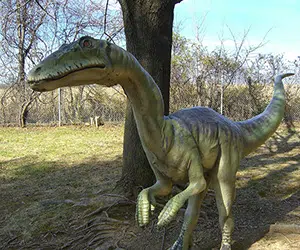
The feature image on this page follows that approach. It presents Eucoelophysis as a small, agile animal with a narrow body, long hind limbs, a balancing tail, and forelimbs held back while running. That arm position is interpretive rather than directly preserved, but it reflects a streamlined running pose in which the elbows are bent and drawn toward the ribcage. Body depth, musculature, skin covering, and coloration are also reconstructed rather than known from direct fossil evidence.
Appearance is one of the most contentious parts of any Eucoelophysis restoration. Some older artworks treated it as a very slender little theropod similar to Coelophysis. More recent interpretations place it among silesaurids, which changes how many artists think about the torso, forelimbs, skull shape, and even likely diet. The result is that different restorations can look surprisingly different even when they are based on the same fragmentary fossil record.
Was Eucoelophysis a Dinosaur?
This is one of the most interesting questions about Eucoelophysis. When it was named in 1999, it was described as a small theropod dinosaur related to Coelophysis. Later work challenged that interpretation and argued that the anatomy did not fit a true theropod. It is now generally treated as a silesaurid dinosauriform rather than a ceratosaur or coelophysoid.
That does not make the animal unimportant. Quite the opposite. Silesaurids sit very close to the origin of dinosaurs, and their exact position has been debated for years. Depending on the study, they may be viewed as close dinosaur relatives outside Dinosauria or as part of a broader early ornithischian branch. Eucoelophysis matters because it sits right in that zone where the boundary between “near-dinosaur” and “early dinosaur-line archosaur” becomes scientifically interesting.
What Did Eucoelophysis Eat?
Diet is less certain than older reference pages often imply. Many dinosaur websites simply label Eucoelophysis a carnivore because it was once treated as a small theropod. That is no longer a safe assumption. With the genus now generally placed among silesaurids, the question becomes more open.
The problem is that diet is hardest to pin down when skull material is limited or uncertain. Cranial material from Hayden Quarry referred to Eucoelophysis includes leaf-shaped teeth with delayed ankylosis, a feature associated with silesaurids. That does not force a single simple answer, but it makes a straightforward “little meat-eater” interpretation less convincing. At present, omnivory or herbivory are both more defensible than confidently calling it a dedicated carnivore. See Breeden et al. (2025).
Reference
Sullivan, R. M., & Lucas, S. G. (1999). Eucoelophysis baldwini, a new theropod dinosaur from the Upper Triassic of New Mexico, and the status of the original types of Coelophysis. Journal of Vertebrate Paleontology, 19(1), 81–90.