Echinodon

Echinodon becklesii was a small heterodontosaurid dinosaur that lived during the Early Cretaceous, in the Berriasian stage, about 145 to 140 million years ago. Its fossils were found in the Purbeck Group of Dorset in southern England. It is estimated to have been about 60 centimetres long.
Scientific name: Echinodon becklesii
Name meaning: Hedgehog tooth
Clade: Ornithischia
Family: Heterodontosauridae
Era: Early Cretaceous (Berriasian, ~145–140 million years ago)
Length: About 60 cm
Diet: Herbivore or omnivore
Location: Dorset, southern England
Fossils: Fragmentary jaws and isolated teeth.
Echinodon Life Reconstruction and Illustration

The feature illustration of Echinodon is a scientific reconstruction based on fossil material and comparisons with closely related heterodontosaurid dinosaurs. Only partial remains are known, including elements of the jaws and teeth discovered in the Purbeck Beds of southern England. These fossils reveal the unusual mixed dentition that characterises the animal, including small canine-like teeth near the front of the jaws and broader chewing teeth further back.
Because the skeleton is incomplete, the overall body proportions are reconstructed using better known heterodontosaurids such as Heterodontosaurus. These comparisons suggest a lightly built, bipedal dinosaur about 60 centimetres long with a long balancing tail and relatively short forelimbs. The illustration also includes likely filamentous body covering based on related ornithischians such as Tianyulong, while the earthy colour pattern is inspired by modern reptiles and ground-dwelling birds.
Echinodon Facts
Echinodon was a very small plant-eating dinosaur that lived in southern England about 145–140 million years ago. It is best known from fragmentary jaw fossils found in the Purbeck limestone beds near Swanage. The animal was only about 60 centimetres long and likely moved on two legs.
Key facts about Echinodon include:
- One of the smallest known ornithischian dinosaurs.
- Known from Early Cretaceous fossils in Dorset, England.
- Named in 1861 by Richard Owen.
- The only species recognised is Echinodon becklesii.
- Possessed unusual canine-like teeth for a plant-eating dinosaur.
The dinosaur is unusual because its jaws contained several different types of teeth. This feature links it with a group called heterodontosaurs, small early plant-eating dinosaurs that sometimes possessed canine-like teeth at the front of the mouth.
Species and Naming
The single recognised species of this dinosaur is Echinodon becklesii. The species name honours Samuel Beckles, the fossil collector who first discovered the remains.
The genus name Echinodon means “hedgehog tooth.” Richard Owen chose this name because the teeth appeared somewhat spiny or pointed when compared with those of other reptiles known at the time.
Fossils and Discovery
The fossils of Echinodon were discovered in the Purbeck Beds near Swanage on the southern coast of England. These rock layers date to the earliest part of the Cretaceous Period, roughly 140 million years ago.
Samuel Beckles collected the original specimen in the nineteenth century. The material was later studied and formally described by Richard Owen in 1861, who initially believed the remains belonged to a type of lizard.
Only partial fossil material has been recovered, which limits how much is known about the dinosaur. However, the preserved bones provide enough information to identify its general anatomy and evolutionary relationships.
Size and Basic Facts
Echinodon was a very small dinosaur compared with most others from the Cretaceous Period. Estimates suggest a body length of about 60 centimetres, making it roughly the size of a small dog.
Its weight is unknown, but it was likely very light. The body plan suggests a small bipedal herbivore that moved quickly and fed close to the ground.
Teeth and Diet
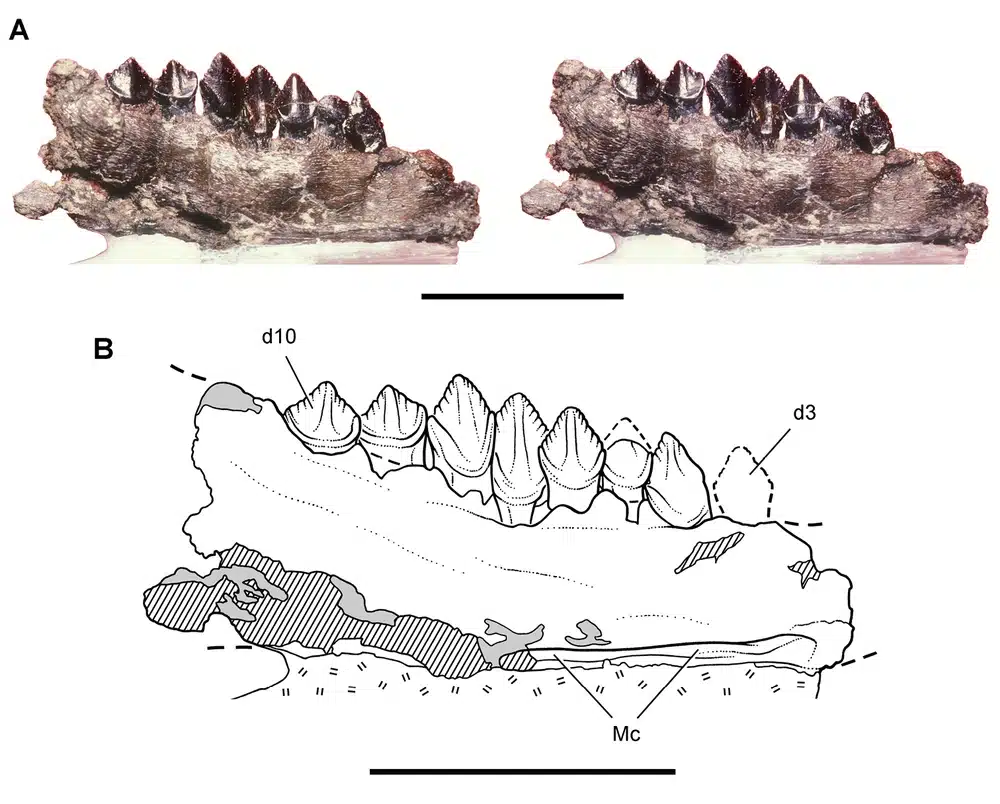
The teeth of Echinodon are one of its most distinctive features. Fossil jaw bones show a mixture of small pointed teeth near the front and broader leaf-shaped teeth toward the back, a pattern typical of heterodontosaurs. This combination suggests the animal was capable of processing plant material while still handling a variety of other foods.
The front teeth appear suited to gripping or slicing softer food, while the rear teeth resemble the grinding teeth seen in many small herbivorous dinosaurs. Because of this mixed dentition, some researchers have suggested that heterodontosaurs may have eaten a varied diet rather than specialising strictly on plants, an interpretation discussed in summaries of Heterodontosaurus.
Only fragmentary fossils of Echinodon are known, mainly jaw bones discovered in the Purbeck Group of southern England. These sediments belong to the earliest Cretaceous and preserve a diverse ecosystem of small reptiles, mammals, and dinosaurs described from the Purbeck Beds.