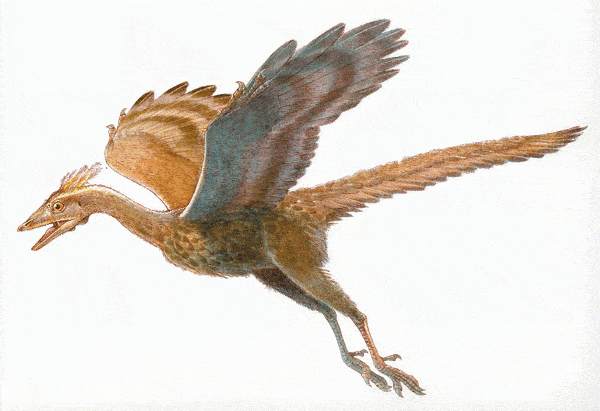
Archaeopteryx

Archaeopteryx atop a misty cliff

Archaeopteryx was a small feathered avialan dinosaur that lived during the Late Jurassic, about 150 million years ago. Its fossils have been found in the Solnhofen limestones of southern Germany. It was about 50 centimetres long and was roughly similar in size to a magpie or small raven.

Scientific name: Archaeopteryx lithographica

Name meaning: ancient wing

Clade: Avialae

Family: Archaeopterygidae

Era: Late Jurassic (Tithonian, ~150 million years ago)

Length: about 50 cm

Diet: Carnivore

Location: southern Germany

Fossils: Multiple skeletons and feather impressions from Solnhofen limestone.

Archaeopteryx Life Reconstruction and Illustration

Reconstruction of Archaeopteryx dinosaur showing full body with feathers, long bony tail, clawed wings, and teeth, displayed on a white background with a 50 cm length scale beneath the animal.
Scientific reconstruction of Archaeopteryx based on fossil skeleton proportions from the Late Jurassic Solnhofen deposits of Germany. The animal is shown at its estimated full body length of about 50 cm.

This life reconstruction of Archaeopteryx is based primarily on well-preserved fossil skeletons from the Solnhofen Limestone of Germany. These fossils show detailed bone structure, including the skull shape, wing proportions, long bony tail, and clawed fingers on the wings.

Feather arrangement and body form are reconstructed from fossil impressions and comparisons with modern birds and feathered dinosaurs. Archaeopteryx did not possess a crest or major head ornamentation, so the head shape follows the known skull fossils.

Archaeopteryx characteristics

Archaeopteryx is famous because it shows a clear mix of bird and dinosaur traits. Its fossils preserve feathers like a bird, but the skeleton still includes teeth, clawed fingers on the wings, and a long bony tail typical of small predatory dinosaurs.

Key features that make Archaeopteryx scientifically important include:

  1. Well-preserved feathers showing early flight adaptations.
  2. A skeleton combining bird features and dinosaur traits.
  3. Fossils dating to about 150 million years ago in the Late Jurassic.
  4. Some of the earliest evidence of powered flight in the bird lineage.

This unusual combination has made Archaeopteryx one of the most important fossils ever discovered. Scientists often describe it as a transitional form because it helps explain how modern birds evolved from small feathered dinosaurs.

Discovery and Importance of the Archaeopteryx Fossil

The fossils of Archaeopteryx lithographica were discovered in the fine limestone deposits of Solnhofen in southern Germany. These Late Jurassic rocks formed around 150 million years ago and are famous for preserving delicate fossils in remarkable detail.

The first discovery was a single fossil feather found in 1860. Shortly afterward, a nearly complete skeleton was uncovered in the same rock layers. Because these fossils appeared soon after Darwin published On the Origin of Species, they quickly became central to debates about evolution.

Archaeopteryx fossils remain among the most scientifically important ever discovered. Only a small number of specimens are known, but their excellent preservation allows scientists to study feathers, bones, and other structures that reveal how early birds evolved from dinosaur ancestors.

Bird and Dinosaur Features of Archaeopteryx

Archaeopteryx is famous largely because its skeleton combines features of both birds and small predatory dinosaurs. This unusual mix has made the animal central to discussions about the origin of birds and its place in the history of life.

The animal possessed clear bird characteristics. It had well-developed feathers, wings capable of generating lift, and a furcula, or wishbone, that strengthened the chest during wing movement. These features strongly connect Archaeopteryx with the lineage that eventually produced modern birds.

At the same time, its skeleton preserved several primitive dinosaur-like traits. Archaeopteryx had teeth in its jaws instead of a beak, a long bony tail made of many vertebrae, and three clawed fingers on each wing. These characteristics are typical of small theropod dinosaurs.

This unusual combination explains why Archaeopteryx is often described as a “missing link” in evolution. It demonstrates how bird anatomy developed gradually from dinosaur ancestors rather than appearing suddenly in the fossil record.

How Well Could Archaeopteryx Fly?

The feathers of Archaeopteryx closely resemble those of modern flying birds, suggesting they were aerodynamic and capable of generating lift. Fossil feather impressions show asymmetrical flight feathers similar to those seen in living birds, a feature widely interpreted as evidence for flight ability.

However, its flight was probably limited compared with modern birds. Studies of its wing bones suggest Archaeopteryx may have used short bursts of flapping flight rather than sustained flight, a view discussed in summaries of early bird evolution such as the Britannica overview of Archaeopteryx.

What Its Skull Reveals About Feeding

Recent fossil analysis has revealed unusual features in the skull of Archaeopteryx that may have helped it handle food more effectively. Researchers identified small projections on the roof of the mouth called oral papillae, which help modern birds grip and guide prey.

Scientists also found evidence of a flexible tongue supported by an additional bone and possible sensory structures near the tip of the jaw. These adaptations suggest Archaeopteryx already possessed some specialized feeding abilities seen in later birds.

Leave a Reply

Your email address will not be published. Required fields are marked *